
SALDRU and ERSA co-host the second edition of the annual December Workshop
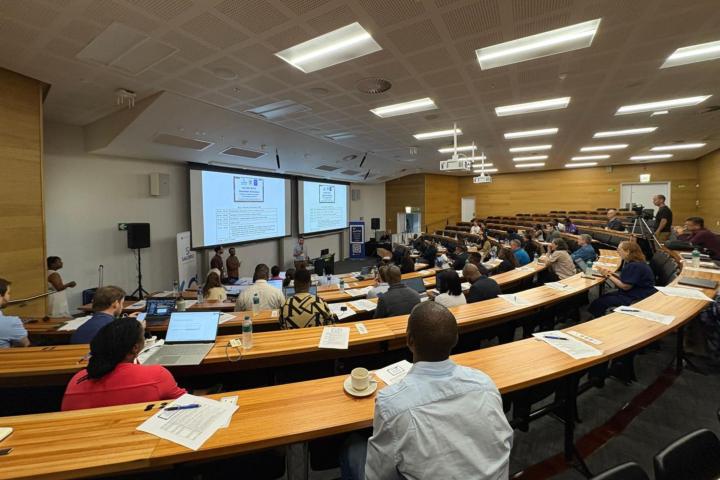
Image: Attendees in the venue where presentations were held at the December Workshop. Credit: SALDRU.
Last month on the 8th and 9th of December, SALDRU co-hosted the second edition of our annual December Workshop, which aims to provide a South African venue where overseas-based and local researchers can present and engage with frontier Economics research under the workshop theme of “Frontiers in Applied Economics for Developing Countries”.
The major change compared to our inaugural version of the event, in 2024, was that in 2025 we co-hosted it with Economics Research South Africa (ERSA), whose generous administrative and financial support for advertisement, participant travel, accommodation, food, audio-visual and logistics made the event much bigger and better. The most exciting part of this was that it enabled us to host attendees from 13 universities across South Africa, helping to fulfil one of the aims of this workshop in providing an accessible local event where people can engage with high-quality international work. Many people from ERSA provided support, and we particularly wish to express our gratitude to Fouché Venter and Claudine Tshabalala.
Besides being bigger and better, the format stayed much the same as the previous year. We had 11 full-paper presentations, 2 PhD panels, and 2 keynote presentations across 2 days, with half of the full-paper presenters being based at South African universities. We had excellent audience participation when it came to questions and the discussion of the presented research, and the programme also made substantial time for informal engagements over coffee and lunches, as well as a dinner for the presenters.
Papers on any applied economics topic in a developing country were encouraged, as long as they used frontier empirical methods or otherwise made compelling empirical contributions. Advertisement via ERSA’s networks meant that we received a very large number of submissions from across the world – over 200 papers! – and so selection was competitive. The scientific committee consisting of us, Taryn Dinkelman, Susan Godlonton and Steve Koch had a challenging task choosing only 11 papers, based on the quality of the research questions and methods.
On to the good stuff: What was presented? Both keynotes were from Professors at the University of Notre Dame. Joseph Kaboski kicked off the workshop with his excellent paper on the effects of outsourcing in Mexico, encouraging us to really think of “outsourcing [as] informality for large firms”. On the other side, Taryn Dinkelman ended the workshop with an incredible, wide-ranging study of the “Labor Market Impacts of Free Primary Education in Africa”, with a micro-level birth-cohort causal design using post-independence national free education policies across 7 countries (Ghana, Kenya, Tanzania, Zambia, Ethiopia, Malawi and Uganda). Both keynotes exemplified the workshop tone of ambitious approaches to important questions with high-quality methods.
In between, the regular slots spanned empirical methods: quasi-experimental, RCTs, and high quality descriptive work with exciting new data exploring pressing questions. To highlight a few of the presentations: Andrew Kerr (UCT) assembled data showing the shocking extent and effects of Cape Town’s recent railways deterioration. Jonas Hjort (UCL) tackled the issue of immigration using South African census data to look at the paradoxical effects on local jobs (positive) and on xenophobic violence (increases). Adeola Oyenubi (Wits) discussed the long-standing question of the effects of South Africa’s Old Age Pension on food vs vice spending. Beyond South Africa, Rob Garlick (Duke) showed cash transfers in Kenya reduced poverty enduringly by overcoming market frictions (paper available here), and Dilan Yang (Oxford) provided city-level estimates of industrial policy investment effects in China. There were many other engaging presentations, including quick-fire PhD panels, with lively discussion more generally.
We are good Saldrupians, so of course we sent around a survey for feedback afterwards. From 30 responses (out of about 70 participants), there was an even split in PhD students and faculty and across gender. About 75% of respondents were based at South African universities, and about a third self-identified as white. The respondents were overwhelmingly happy with the topic range, paper quality and SA/international mix of presenters. In free-text responses, respondents particularly praised the logistics and organisation of the conference - for which we owe thanks to ERSA as well as the SALDRU administrative team - as well the networking opportunities and quality of presentations. All respondents said that they would highly recommend the workshop - a leading survey question if ever there was one - but we’ll take the positive feedback!
Given its success, we expect to continue hosting this event as an annual December Workshop. Please spread the word, and remember to look out for the call for papers which we’ll put out around the middle of 2026.