
SALDRU and IIASA Launch New Fellowship Programme in Demography, Human Capital, and Sustainable Development
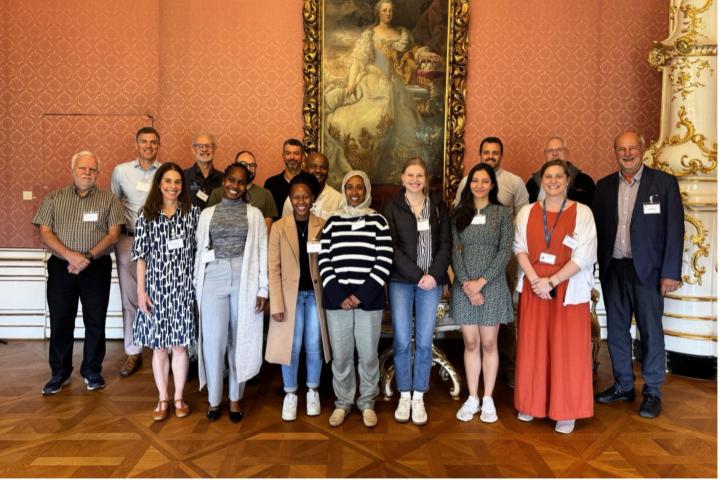
Image: Researcher team pictured at IIASA in Laxenburg, Austria. Credit: Katherine Ivanschits.
A new collaboration on demography and human capital

SALDRU has entered into an exciting three-year collaboration with the International Institute for Applied Systems Analysis (IIASA) to support the next generation of African researchers working at the intersection of education and demography. This project, titled Human Capital for Sustainable Development: A Focus on Africa and Coastal Regions, builds on decades of scientific work coming out of IIASA’s Population and Just Societies Program, in partnership with the Vienna Institute of Demography of the Austrian Academy of Sciences and the Department of Demography at the University of Vienna (as part of the Wittgenstein Centre for Demography and Global Human Capital), which has led the development of multidimensional demography and placed education at the core of population dynamics and sustainable development. Led by 2024 Yidan Prize laureate Wolfgang Lutz, the project aims to apply these methods to demonstrate to policymakers the long-term benefits of near-term investments in quality education in Africa.
The project aims to strengthen research capacity, inform policy, and enhance education data systems. These efforts aim to position education at the heart of development planning – particularly in regions facing both demographic shifts and environmental challenges.
The initiative brings together six early career scholars – three PhD candidates and three postdoctoral fellows – who were carefully selected from a pool of more than 150 applicants across the continent. The inaugural cohort includes PhD students Joana Kwewa (Ghana), Relebohile Mariti (Lesotho), and Chantelle Ngwenya (Zimbabwe), alongside postdoctoral fellows Cynthia Fonta (Cameroon), Tatenda Mugwendere (Zimbabwe), and Emma Whitelaw (South Africa). They will be enrolled at UCT and mentored by a team led by Nicola Branson, with Brendan Moughan-Brown, Tom Moultrie, Murray Leibbrandt, Muna Shifa, and Emma Whitelaw serving as mentors and supervisors. Moultrie, from UCT’s demography department, will oversee the work of both Chantelle and Tatenda.
SALDRU’s scholars will be trained in demographic modelling, while contributing to the generation of country-specific policy scenarios, and organizing and participating in policy workshops. A major output will be a publication on Africa’s future human capital, outlining alternative education trajectories for sub-Saharan African countries. The project also aims to build a sustainable foundation for ongoing research through partnerships.
Launching the programme
The programme began with a five-day meeting at IIASA’s Schloss Laxenburg headquarters in September 2025. Scholars presented their research interests and engaged with IIASA experts on topics ranging from education measurement and model design to the long-term benefits of investment in education.
The scholars’ research interests span a wide range of pressing issues, including the relationship between maternal education and early childhood development, and the effects of free education policies on education quality, dropout, and labour market outcomes. Their work reflects both the diversity of their backgrounds and the programme’s ambition to anchor new research capacity on human capital development within Africa.
Day two coincided with the Wittgenstein Centre’s annual gathering, where the team joined researchers, who develop and apply the centre’s model, in breakout sessions on fertility, mortality, migration, and education to inform the next round of the centre’s global population projections, such as those illustrated below:

Image: Wittgenstein Centre Human Capital Graphic Explorer. Interact with the data yourself, here.
Most of the African team contributed to the education session, bringing perspectives on how demographic models might better reflect African realities.
Beyond the formal programme, the week also gave the team time to soak in Vienna’s rich cultural setting. Between sessions, the team was struck by the ornate architecture and history that seemed to greet them at every corner. On the second evening, the group shared a lively social dinner in one of Vienna’s oldest restaurants, reached only after descending several flights of stone steps deep into the basement. The final days offered space for further discussions and exploration of upcoming project activities, emerging research directions, and potential collaborations. Time was also enjoyed wandering through Vienna’s grand streets and landmarks, deepening connections with one another while experiencing the city’s beauty.
Looking ahead, the collaboration aims to seed a sustainable centre of excellence in Africa that will draw on the combined strengths of SALDRU and IIASA, while building a network of scholars committed to advancing policy-relevant research on education and population dynamics. More information about the project can be found here.

Image: The team pictured on Day 2, which began with a tour of Vienna’s Austrian Academy of Science Building, led by Professor Lutz. Credit: Stefanie Andruchowitz.
About the Yidan Prize

The Yidan Prize is the world’s highest accolade in education. Established in 2016 by philanthropist Charles CHEN Yidan, it champions change-makers who have contributed significantly to the theory and practice of education, through two prizes in Education Research and Education Development. More on the Yidan Prize: yidanprize.org.