
A message from departing SALDRU Director Reza Daniels
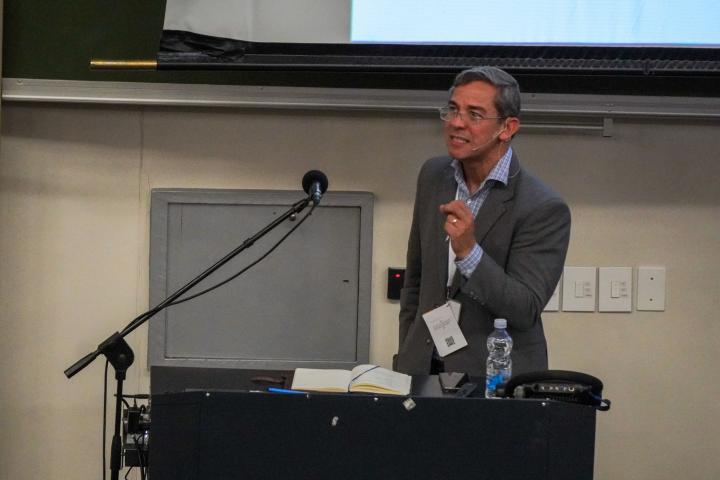
Image: Reza Daniels speaking at the South Africa at 30 Years of Democracy conference. Credit: SALDRU.
After twenty-two months as Executive Director of SALDRU, I will be stepping down from this role. It has been a privilege to serve an institution whose scholarship has shaped South Africa’s socio-economic policy discourse for over half a century. Our shared priority over this period was to position SALDRU for its next chapter as a research centre within the university—maintaining intellectual independence while strengthening governance, operational resilience, and external impact. Together, we:
Completed the process to transition from a research unit to a research centre, updating statutes, delegations, and compliance frameworks to align with university requirements. This will be ratified by the University Research Committee in the coming weeks.
- Built finance and operations capability to meet more stringent planning, budgeting, and management-reporting standards, including clearer project controls and risk management.
- Strengthened our Survey & Data Hub, securing new projects and adding staff capacity in survey operations, data engineering, and reproducible analytics.
- Led a national research programme on food insecurity, delivering timely evidence on prevalence, severity and drivers, and advancing measurement practice for policymakers and practitioners.
- Advanced data harmonisation for national assets: our data team completed the harmonisation of NIDS and NIDS-CRAM to the Cross-National Equivalence File (CNEF), enabling international comparability and longitudinal analysis. This CNEF release (see cnefdata.org) is forthcoming and will broaden the research frontier for South Africa.
- Developed a strategic framework for Public Employment Programmes (PEPs) in South Africa. This was an applied research effort funded by the International Labour Organization (ILO) and presented to the National Department of Employment and Labour for consideration and adoption. The framework develops a theory of change for PEPs and links programme design to labour-market frictions, local capability, and evidence-based targeting.
- Hosted “South Africa at 30 Years of Democracy”, a major national conference in the tradition of the 1980s SALDRU Carnegie II Enquiry and the 2012 SALDRU Towards Carnegie III conference—each a seminal moment for social policy debate. This brought together researchers, government, civil society and business into one room to focus on the next steps for South Africa.
- Built global networks at the energy–labour transition interface, fostering partnerships across academia and civil society to align climate ambition with decent work and regional industrial strategy.
- Contributed internationally recognised scholarship: I co-authored a paper in Nature Communications on the challenges of realising a just labour transition within the broader energy transition, amplifying SALDRU’s voice in a fast-moving global conversation.
These achievements reflect collective effort. I am deeply grateful to our staff, students, and postdocs; to our colleagues across UCT; and to our funders and partners, both local and global, who backed rigorous, policy-relevant research.
SALDRU enters its new phase with stronger governance and operations, a deeper data and survey capability, a renewed public-interest research agenda, and a broader global network at the nexus of energy, industry and labour markets. I have supported a smooth handover to Prof. Vimal Ranchhod, who will take over as the new SALDRU Director from 1st November 2025.
Thank you for the opportunity to serve. I leave proud of what we have built together and confident that SALDRU’s next chapter will deliver even greater research impact and public value.